


About Adoption
A UK Spanish Greyhound, Podenco and other Sighthound Rescue
Our Adoption Criteria & Safety Requirements
Project Galgo is a UK-based rehoming charity and we do not rehome our dogs outside the UK.
Every application is considered individually. We look carefully at the needs, personality and history of each dog alongside the circumstances, experience and lifestyle of the prospective family. There is no one-size-fits-all approach to finding the right home.
Above everything else, the safety and welfare of our dogs will always be our priority.
Gardens & Fencing
If your property has a garden, the fencing must be appropriate for the individual dog. For many of our dogs, we require fencing of approximately 6 feet, although there are exceptions and every home and dog will be assessed individually. We may ask you to make reasonable adjustments to fencing, gates or other areas before an adoption can proceed.
We do not accept electric fencing or sheep-wire fencing as suitable secure boundaries for our dogs.
Our Safety Kit Is Mandatory
As part of our foster and adoption agreement, every Project Galgo dog must use our approved safety equipment.
This includes an approved three-point escape-proof harness, a house collar with identification tag and the appropriate lead. For at least the first three months following adoption, your dog must also wear a Tractive GPS Tracker in accordance with our safety requirements.
Only harnesses specifically approved by Project Galgo may be used.
These requirements exist because we know how quickly a newly arrived or frightened dog can escape, particularly during the early stages of settling into an unfamiliar environment.
Our safety requirements are a condition of adoption. If you are unable or unwilling to commit to them, please do not submit an application.
You can read more about why we insist on appropriate escape-proof harnesses here.
Training & Equipment
Project Galgo advocates kind, ethical and reward-based training.
We are strongly opposed to aversive, punishment-based and dominance-theory training methods and do not permit their use with Project Galgo dogs.
This includes, but is not limited to, prong collars, electronic/shock collars, anti-bark collars, spray collars, invisible/electric fencing, shaker cans, head halters, lead jerking or other equipment or techniques designed to cause pain, fear, discomfort or intimidation.
We also do not permit retractable leads or slip leads.
The use of crates in the home is prohibited for Project Galgo dogs.
If you experience behavioural difficulties after fostering or adopting, we would much rather you speak to us. We are here to support you and your dog and, where necessary, help you access appropriate force-free behavioural support.
Hunting Homes
We do not rehome our dogs to households where dogs are used for hunting.
Many of the dogs who come into our care have already experienced exploitation, abandonment or trauma associated with their previous lives. Our commitment is to provide them with safe, secure homes where they will live purely as loved companions.
Where We Rehome
We rehome throughout the UK, including England, Wales, Scotland and the Isle of Wight.
Our foster homes are located across the country, and the location of the dog you are interested in may therefore be some distance from your home.
Prospective adopters must be willing to travel to the dog’s foster home to meet them before adoption. We are unable to move dogs between foster homes simply to facilitate an adoption meeting.
If you already have a dog or dogs, we will normally ask you to bring them with you to the meeting. This allows us and the foster carer to observe introductions and helps us assess whether everyone is likely to be comfortable living together.
Our foster network currently includes homes across Essex, Sheffield, the Midlands, Wales, Hertfordshire, Gloucestershire, Herefordshire, West and East Sussex, Buckinghamshire, Cumbria, Liverpool, Cambridgeshire, Norfolk, Surrey, London, Kent, Bristol, Somerset, Devon, Cornwall, Nottinghamshire, Northampton, Yorkshire, Newcastle, Leeds, Derbyshire and Scotland.
We know that some of our requirements are more stringent than those of other organisations, but they are there for one reason: to protect the dogs entrusted to our care. When we say yes to a dog, our responsibility for their safety and welfare does not end when they reach their new home.
The Adoption Process
If you have read the criteria above and feel that you can meet our adoption requirements, the next step is to submit an adoption application.
What happens next?
1. We review your application
Please allow us a couple of days to process your application. We are a volunteer-run charity and always try to respond as quickly as possible.
If you have not heard from us within three days, please check your email spam/junk folder first. If there is nothing there, please contact us.
2. Your homecheck
If your application is successful, we will arrange a homecheck. This will either be carried out by a volunteer visiting your home or, where appropriate, via video call at a mutually convenient time.
The homecheck gives us an opportunity to get to know you and your household a little better, discuss your expectations and experience, and assess the security and suitability of your home and garden.
We will also require a form of identification for verification purposes.
3. We confirm the outcome
Following your homecheck, we will let you know the outcome as soon as possible. Please allow at least one day for this process.
4. Finding the right dog
Once approved, we will discuss the dogs we believe may be a suitable match for you, taking into account both your circumstances and the individual needs of each dog.
Where a dog is already in UK foster, you will have the opportunity to speak directly with their foster carer. This is an important part of the process, as nobody knows the dog’s day-to-day personality, behaviour and needs better than the person currently caring for them.
If everyone feels comfortable proceeding, a meeting can then be arranged. Depending on the individual dog, your circumstances and foster-carer availability, more than one meeting may be recommended or arranged.
5. Confirming the adoption
An adoption is only complete when all required steps have been completed. These will include signed adoption agreements, payment of the adoption fee, any relevant medical or care documentation, and final approval checks.
Until all steps are complete, the dog remains in Project Galgo’s foster care and under Project Galgo’s responsibility.
Reserving a Dog
Please be aware that we cannot reserve a dog simply on the basis of an application or expression of interest.
For a dog in UK foster, a reservation can only be confirmed once:
Your homecheck has been successfully completed, Project Galgo has approved the match, the adoption contract has been signed, and the adoption fee has been paid.
Once the adoption has been confirmed, we understand that it may not always be possible to collect your dog immediately. Where agreed with Project Galgo, an alternative collection date can be arranged, normally no later than three weeks after your meeting.
The signed contract and adoption fee will still be required at the point the adoption is confirmed, rather than on the later collection date.
Our process may sometimes feel thorough, but there is a reason for every step. Our priority is not simply to find a home for each dog, but to find the right home — one in which both dog and adopter have the very best chance of a happy and successful life together.
A Volunteer-Run, Not-for-Profit Charity
Project Galgo is a not-for-profit registered charity run entirely by volunteers, many of whom also work full-time. No member of our team receives a salary or wage from Project Galgo.
The funds we receive through adoption fees, donations and fundraising go directly towards our charitable work — helping us care for dogs in foster, meet rescue and rehoming costs, and, importantly, continue helping more dogs in need.
Adoption Fee Payment
Once an adoption has been confirmed, we ask that the adoption fee is paid promptly so that we can finalise the necessary arrangements for your dog.
Dogs travelling directly from Spain:
Where your dog is travelling directly from Spain to you, the adoption fee must be paid in full on the day the adoption is confirmed, or in advance of their journey where requested.
Dogs adopted from UK foster:
Once you have verbally confirmed that you wish to adopt a dog from foster, we require the signed adoption contract and full adoption fee within 24 hours.
We appreciate your understanding. As a small charity, prompt payment enables us to meet the costs associated with each adoption and ensures that funds can continue to be directed towards the next dog waiting for our help.
Adoption Fees
At Project Galgo, we do not ask adopters to cover the full cost of bringing a dog safely to the UK. We want to make adoption as accessible as possible while ensuring that every dog receives the care and protection they need.
A typical breakdown for each Galgo and Podenco is:
| Cost | Amount |
|---|---|
| Adoption fee paid to the Spanish shelter | £250–£300 |
| DEFRA-approved transport to England/Wales, including documentation | £500 |
| DEFRA-approved transport to Scotland, including documentation | £550 |
| Project Galgo safety kit | £60 |
| Tractive GPS Tracker | £59–£69 |
| One-year Tractive subscription | £120 |
| Brucella Canis test* | From £100 |
*Brucella Canis testing is payable separately by the adopter. The cost starts from approximately £100 and may vary depending on the veterinary practice.
The breakdown for a Saluki is:
| Cost | Amount |
|---|---|
| Transportation from Bahrain to Paris by plane | From £700 |
| Transportation from Paris to the UK via Eurotunnel | From £300 |
| Project Galgo safety kit | £60 |
| Tractive GPS Tracker | £59–£69 |
| One-year Tractive subscription | £120 |
| Brucella Canis test* | From £100 |
*Brucella Canis testing is payable separately by the adopter. The cost starts from approximately £100 and may vary depending on the veterinary practice.
This means it costs approximately £989–£1,099 for each Galgo and Podenco and £1239 for a Saluki to be prepared for adoption and brought safely into our care in the UK — and this is before food, any additional veterinary treatment or unexpected costs are taken into account.
Despite these costs, our adoption fees are £750 for a Galgo or Podenco and £800 for a Saluki.
This includes the purchase of the dog’s Project Galgo safety kit and the purchase or 3 month loan/use of a Tractive GPS tracker for the first three months.
For our senior dogs aged 10 years and over, we offer a reduced adoption fee, which is considered on an individual basis.
In exceptional circumstances, we can accept the adoption fee in two consecutive instalments. As a small, not-for-profit charity, however, we are unfortunately unable to offer longer-term or smaller instalment arrangements.
Helping Us Bridge the Gap
Our adoption fee does not cover the full amount we spend on each dog. Project Galgo meets the shortfall through fundraising and the generosity of our supporters.
If you are in a position to cover the full cost of bringing your dog to the UK, or would like to make an additional donation alongside your adoption fee, we are enormously grateful. Any additional contribution helps us meet that shortfall and, importantly, helps us say YES to the next dog waiting for their chance.
DISEASE TESTING
All of our dogs are tested for Mediterranean and vector-borne diseases while in shelter in Spain, using PCR and 4DX testing. If a dog receives a positive result, they will receive appropriate treatment before travelling to the UK.
Leishmaniasis
If a dog tests positive for Leishmaniasis, they will receive the necessary treatment in Spain. Once they are well enough to travel, they will be maintained on a weight-appropriate dose of Allopurinol, where prescribed.
Dogs diagnosed with Leishmaniasis require ongoing veterinary monitoring and evaluation after adoption. It is a chronic condition and they may relapse. For this reason, every Project Galgo dog with a Leishmaniasis diagnosis is adopted subject to our Leishmaniasis Disclosure and Care Agreement.
This agreement ensures that adopters fully understand their dog’s condition, treatment and monitoring requirements, and their commitment to following veterinary guidance, maintaining appropriate ongoing care and sharing relevant veterinary information with Project Galgo.
Further information can be found in our Leishmaniasis and Other Endemic Conditions section.
Annual Testing
All Project Galgo adopters are required to arrange annual 4DX tests in addition to the Leishmaniasis serology test.
This screens for:
Anaplasma • Ehrlichia • Heartworm (Dirofilaria) • Lyme disease
If the results remain negative, 4DX testing should then be repeated annually as part of your dog’s ongoing preventative healthcare.
If any result is positive, your veterinary practice will be able to advise on and provide the appropriate treatment. Following a positive result, the affected disease should be retested by PCR approximately six months later, alongside any appropriate blood and/or urine analysis recommended by your veterinary surgeon.
Salukis from Bahrain
Our Salukis arriving from Bahrain are also tested for relevant endemic and vector-borne diseases and receive any necessary treatment before travelling.
Following adoption, they also require annual 4DX testing, but not Leishmaniasis.
If a test returns a positive result, your veterinary surgeon will advise on the appropriate treatment and follow-up care. The affected disease should subsequently be retested by PCR approximately six months later, together with any appropriate blood and/or urine analysis.
These ongoing tests are an important part of looking after dogs who have lived in countries where diseases uncommon in the UK may be present. Regular monitoring allows us—and you—to give them the best possible chance of remaining happy and healthy throughout their lives
Safety Comes First
One of the most important aspects of adopting a rescue dog is keeping them safe.
For Project Galgo, our safety procedures were born from experience — and from a promise we made after one particularly frightening escape.
Why we take safety so seriously
In 2020, a Galga named Willow arrived from Spain to begin the next chapter of her life. She had spent several years in a shelter and had finally reached the point where she was ready to move into foster care.
Just one day after arriving in the UK, Willow escaped from her foster mum’s car before she had even made it through the front door.
She was in the Forest of Dean, an environment completely unfamiliar to her. She had endured a long and confusing journey from Spain, knew nothing of her surroundings and had not yet had any opportunity to build a relationship or bond with her foster carer.
Willow was terrified — and she ran.
She remained on the run for weeks. Thankfully, there were regular sightings and she stayed relatively close to the area from which she had escaped, but she was frequently running close to busy roads. In her frightened state, nobody could get near enough to secure her, and attempts to approach or catch her risked pushing her further away.
Eventually, after an incredibly worrying few weeks, Willow was safely captured.
That experience stayed with us, and we made a promise: we would do everything within our power to reduce the risk of one of our dogs finding themselves in the same situation.
Sadly, the danger is very real. Around the same period, two Galgos rehomed through another organisation also escaped. Cooper was tragically killed after being struck by a car. Gepetto, who had been in his new home for less than 12 hours, escaped and remained on the run for several days. Despite coming heartbreakingly close to being caught, he too was subsequently killed on the road.
These experiences are why our safety requirements are not optional and why we ask every Project Galgo adopter and foster carer to follow them carefully.
GPS Tracking
Every Project Galgo dog is provided with a Tractive GPS Tracker, which must be worn for at least the first three months following adoption.
Those first weeks and months are particularly important. Your new dog does not yet know that you are their family, that your house is their home or that, if frightened, they should return to you.
A GPS tracker cannot prevent an escape, but should the unthinkable happen, it can provide invaluable information about your dog’s location and significantly assist efforts to bring them safely home.
Their safety is everything to us — and to the shelters and rescuers who entrusted them to our care.
The Project Galgo Safety Kit
Every dog travels to their new home with an approved Project Galgo safety kit. This includes:
- An approved, adjustable three-point escape-proof harness
- A house collar with Project Galgo identification tag
- A suitable lead
- A tracker pouch designed to hold the Tractive GPS Tracker securely on the house collar
- A Tractive GPS Tracker
Our approved escape-proof harnesses include models from Mis Canijos, Haqihana Double H, Houndstuff, Ruffwear Flagline and Ruffwear Webmaster.
Your dog’s safety equipment should be used in accordance with the guidance provided by Project Galgo.
Equipment & Training
Project Galgo does not permit the use of retractable leads with our dogs.
We also do not support aversive or dominance-based training methods or equipment, including head halters. We advocate kind, reward-based training, giving each dog the time, patience and understanding they need to feel safe and build trust.
Our job — together with our adopters and foster carers — is to make sure that once they reach safety, we do everything possible to keep them safe.


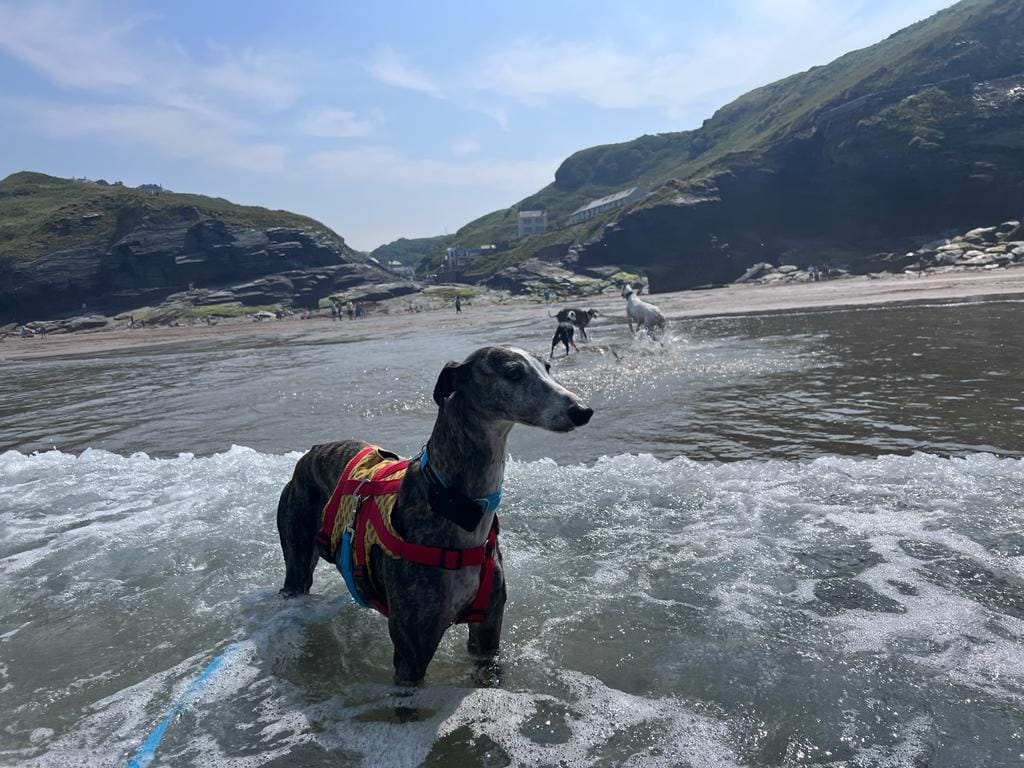
After Adoption
We like to maintain contact with all our adopters – part of the joy in what we do is to see them blossoming and thriving in their forever homes. We also like to pass updates onto the shelters we work with.
Following adoption, we offer a free behavioural support package for 3 months after adoption via two of our Trustees, Samantha Walker-Arends and Pennie Clayton (also our Patron).
In the very sad event you are unable to continue to care for your adopted dog, we ask you to contact us to make arrangements for the dog to come back into foster care with us.
It is essential for all Spanish dogs to have annual PCR and 4dx tests and for Bahrain dogs, annual 4dx tests.